

Project management can be transformative in K-12 school districts, ensuring that strategic initiatives are executed effectively to support student achievement and district goals. Strong project management fosters collaboration, accountability, and alignment with district priorities. Conversely, an absence of or weak project management can result in wasted resources, missed opportunities, and stakeholder frustration. While large and corporate organizations often have the resources to develop and invest in a fully-staffed Project Management Office (PMO), project management fundamentals can be implemented into existing school district structures and departments in a timely and budget-friendly manner.
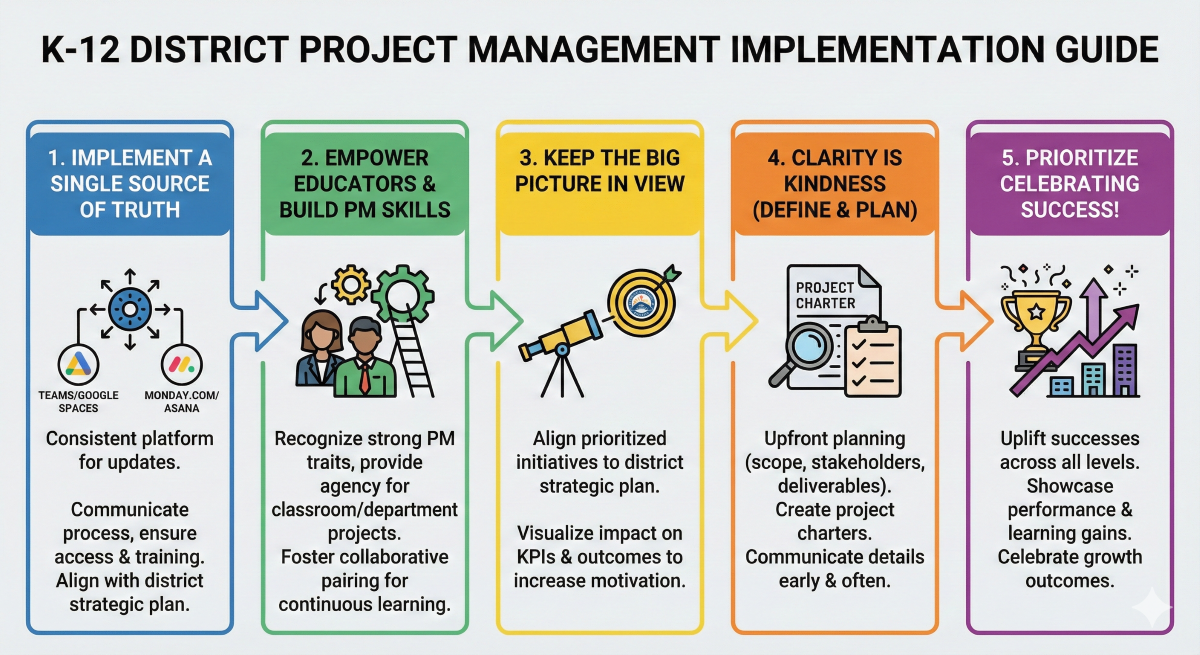
To ensure success, districts should consider adopting these five best practices: implement a dedicated platform & process to capture project updates, empower educators to develop project management skills, maintain a clear focus on the district’s strategic vision, emphasize clarity in project planning, and celebrate successes. Together, these practices promote efficiency, continuous improvement, and a culture of collaborative achievement across the district.
- Implement a Single Source of Truth. Determine a consistent platform and process for stakeholders to leverage in providing updates regarding the prioritized, strategic projects they are working to complete during the school year. Be sure that process is communicated to all stakeholder groups and teams across the district and that they have the appropriate access and the necessary training. This could be as simplistic as Teams Channels / Google Spaces or more robust in a PM platform like Monday.com or Asana. In our work with school districts, launching a PM platform often begins with the district’s strategic plan implementation and includes collaboration from each department.
- Empower Educators to Build their Project Management Skills. Recognize the characteristics of strong project management in employees and provide them with the agency to implement the projects they are working towards within their classrooms, their department, and/or within their professional growth plans. *Bonus points: Find opportunities to pair individuals with others that have complementary strengths or project goals, fostering a culture of continuous learning and improvement.
- Keep the Big Picture in View for Everyone. Provide the framework for project leaders to seamlessly align their prioritized project initiatives to the district’s strategic plan and vision of the organization. When project leaders, teams, and individuals can see their work tied directly to the district’s strategic objectives, the progress and impact of that work heightens the educators’ innate mission of Making a Difference! There is excitement and increased motivation when employees can see their footprint in the data, moving the needle towards KPIs and outcomes. In recent project management professional learning sessions completed with a partner district, team members shared: “It will help us accomplish our project goal in an efficient and timely manner. The support provided has been critical to our planning and preparation to roll out this project.”
- Clarity is Kindness. Time spent upfront on defining and planning a project (including scope, stakeholders, deliverables, assumptions, constraints, & exclusions) by creating a project charter, is time well spent. A solid project framework will save time, resources, and frustration for all stakeholders throughout the project. Ensure those finely tuned details (including any updates along the way) are communicated and shared early and often throughout the project lifecycle. During PM Leadership Consulting, district participants shared that the ALP facilitator provided “Clarity, organization and great communication skills. The strategies and support provided were key to my learning.”
- Prioritize Celebrating Success! School districts are uniquely positioned to benefit from project management uplifting successes across department, grade level, and building lines, and showcase performance throughout the district. Success in education projects is best celebrated through the learning gains and growth outcomes they enable. Consider opportunities for employees to:
- Track and celebrate gains in knowledge, recognize an increase in skills & project progress and performance.
- Share reflections on growth and team collaboration.
- Honor competency gains in the ability to reflect, revise, and plan future projects.
Incorporating project management practices into your district doesn’t have to be overwhelming or time consuming – start small! Begin by defining what’s most important for your district, building, or department goals, then gradually introduce systems and processes that fit your unique needs. Allocate resources and support where they matter most and make sure everyone has the tools and training needed to thrive. Remember to keep the momentum going by celebrating successes along the way – every small step forward is a win! By empowering educators, staying aligned with your district’s big picture, and fostering collaboration, you’ll create a culture of continuous growth – one that’s grounded in practical steps and meaningful progress.
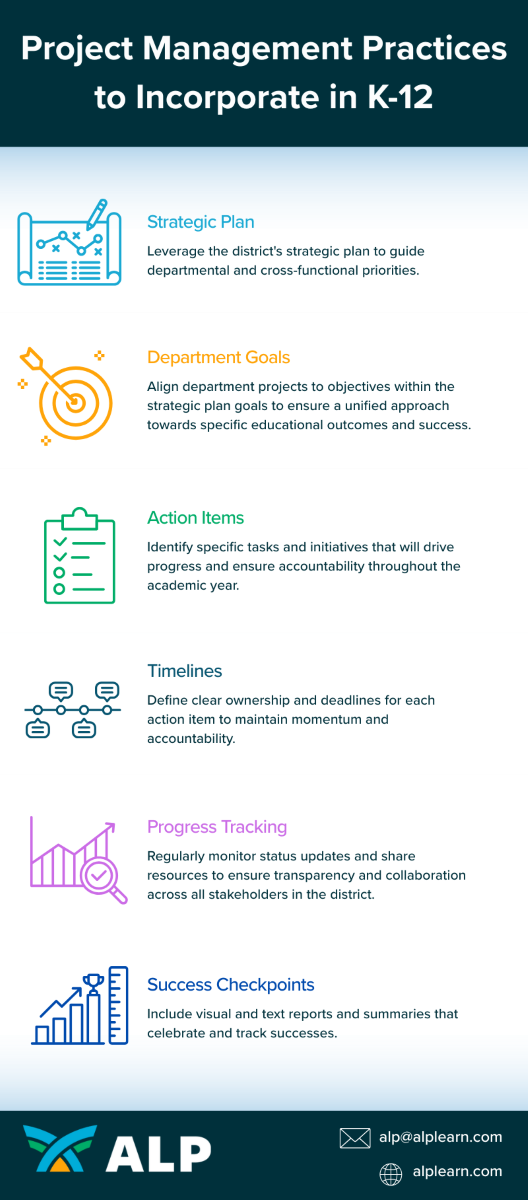
In working with some of ALP’s district partners, another example of this in action was in guiding department level leaders towards identifying their strategic action items for the school year, as nested within their district’s larger strategic plan, developing timelines and owners for those action items, and tracking action item status over time with consistent updates, collaborative resources, and progress monitoring. Within their chosen project management platform, we were able to build in success checkpoints that included visual and text reports and summaries and automate several workflow functions. Throughout implementation, we’ve received positive feedback on the participants’ project management professional learning experiences:
- “Time spent on basic components of project management and time to talk through scenarios and explore options in [our project management platform] were helpful.”
- “Creating a real-world project was very helpful. I was able to get the bones of a project set up and talk through what would be good to adjust in it.”
- The benefits of the professional learning “will help our department plan and execute projects more effectively.” It will provide us with “better collaboration on projects.”
For more information on ALP’s project management professional learning opportunities, see our Strategic Planning, specifically implemented in Phase 4, and our Leadership Consulting services.
Jennifer Pineda is an eternal optimist and passionate about learning for life while helping others in their growth and development journey. From a young age, her love of learning and teaching others led Jennifer to the field of education. Throughout her career, she has enjoyed leading adult learners in a variety of settings. Jennifer has taught high school and college students, led online higher education programs and coached faculty, managed educational programs in for-profit and government agencies, and directed business solutions including data analytics, SaaS implementations, and program management. She is passionate about creating process efficiencies through project management with diverse teams within organizations. When not engaged in work and professional development, you can find Jennifer enjoying being active, from exploring nature with her family to training for her next triathlon.
